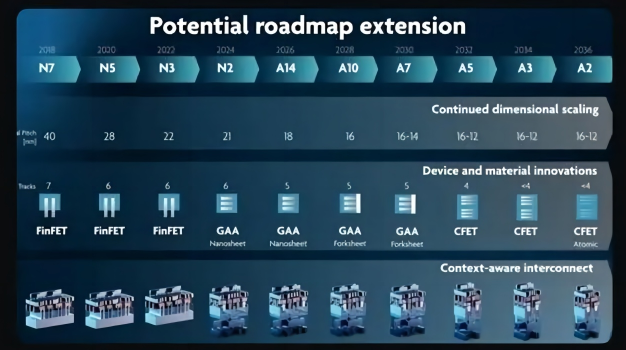
Intel's new stacked CFET transistor architecture revealed, expected to advance the process to 0.2nm
Views : 180
Update time : 2023-05-25 11:56:30
May 24 news, recently held in Antwerp, Belgium, ITF World 2023 conference, Intel technology development general manager Ann Kelleher introduced several key areas of the latest technological developments, including Intel will use the stacked CFET transistor architecture, which is the first time Intel publicly introduced the new transistor design, but did not mention the specific mass production Timetable.
At the 2021 Innovation Technology Conference, Intel announced the Intel 20A process will use Gate All Around (GAA) technology based RibbonFET transistor architecture to replace the FinFET transistor architecture used in 2011 to date. Ann Kelleher said that RibbonFET will be in mass production in 2024. Intel is also demonstrating a next-generation GAA stacked CFET transistor architecture that will allow stacking of eight nanosheets, twice the four nanosheets of the RibbonFET, which will further increase transistor density. CFET transistors stack n and p MOS elements together to achieve higher densities. Intel is working on two types of CFET transistors, namely monolithic and sequential, but has not determined which CFET transistor will be used in the end, or if other classes of designs will emerge. Intel said that with CFET transistor technology, 2032 will be expected to evolve to 5 em (0.5nm), 2036 will be expected to achieve 2 em (0.2nm), CFET transistor architecture type will also change, is also inevitable. However, Intel only outlines the approximate development blueprint of transistor technology, and does not share too many details, the future should also successively disclose more information published.
The LDK220 series of low-dropout linear regulators (LDOs) is a high-performance device designed specifically for low-power consumption and high-precision voltage regulation, widely used in scenarios such as consumer electronics, industrial control, and po
Xilinx Spartan®-7 FPGA Family stands as a defining solution in the mid-range FPGA landscape, blending high performance, energy efficiency, and cost-effectiveness to redefine versatility for industrial, IoT, and consumer electronics applications. Built on
The Altera FLEX series was more than a lineup of FPGAs—it was a blueprint for how programmable logic devices could evolve to meet diverse market needs. The FLEX 8000 laid the architectural groundwork, the FLEX 10K redefined functionality with embedded mem
Among TI standout offerings, the LM4765 and LM4766 are dual-channel amplifiers designed to cater to diverse audio needs—from compact setups to high-fidelity systems. While sharing the same product lineage, these chips differ significantly in power output,