A paper capacitor is a type of passive electronic component designed to store electrical energy in an electric field. It belongs to the family of film capacitors, where the dielectric material—responsible for separating the conductive plates and enabling charge storage—is made from paper. Renowned for its simplicity, affordability, and historical significance, the paper capacitor has played a pivotal role in early electronics and continues to find niche applications today.
Paper Capacitor Construction and Design
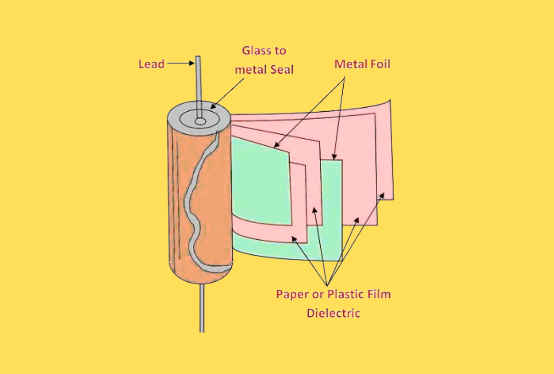
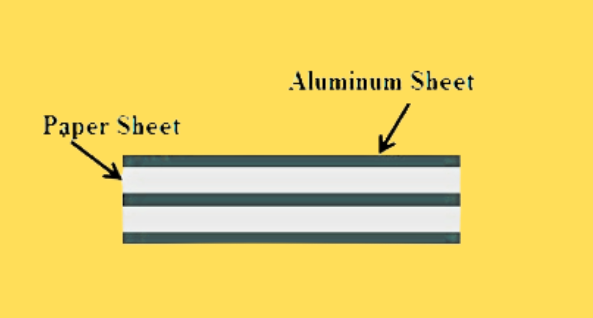
The basic structure of a paper capacitor consists of three key components:
- Dielectric: A thin sheet of paper, often treated with wax, oil, or plastic to enhance its insulating properties and moisture resistance. The paper’s porosity allows it to absorb these substances, improving dielectric strength (the ability to withstand voltage without breakdown).
- Electrodes (Plates): Two conductive layers, typically made of aluminum foil or metalized paper (a thin layer of metal deposited directly onto the paper). These plates sandwich the dielectric, forming the capacitor’s conductive surfaces where charge accumulates.
- Encapsulation: The layered structure (paper dielectric + metal plates) is rolled into a cylindrical shape to save space, then enclosed in a protective casing—often made of cardboard, plastic, or metal—to shield it from physical damage and environmental factors like dust and humidity.
Paper Capacitor Working Principle
Like all capacitors, a paper capacitor operates on the principle of electrostatic charge storage. When connected to a voltage source, electrons accumulate on one electrode (creating a negative charge), while the other loses electrons (developing a positive charge). The paper dielectric prevents direct current (DC) from flowing between the plates but allows alternating current (AC) to pass by charging and discharging as the voltage polarity reverses.
The capacitance (C), measured in farads (F), depends on:
- The area of the electrodes (larger area = higher capacitance).
- The thickness of the paper dielectric (thinner dielectric = higher capacitance, up to a limit where breakdown risk increases).
- The dielectric constant (k) of the paper (enhanced by treatments like waxing, which raises k and improves performance).
Types of Paper Capacitors
Paper capacitors are categorized based on their dielectric treatment and construction:
- Waxed Paper Capacitors: The paper is impregnated with wax to repel moisture and increase dielectric strength. Common in low-voltage, audio-frequency applications.
Waxed Paper Capacitors
- Oil-Impregnated Paper Capacitors: The paper is soaked in mineral oil or synthetic oil, boosting dielectric strength and heat resistance. Used in high-voltage scenarios, such as power distribution equipment or vintage radio transmitters.
 Oil-Impregnated Paper Capacitors
- Metalized Paper Capacitors: Instead of separate metal foils, a thin metal layer (e.g., aluminum) is vacuum-deposited onto the paper. This design reduces size and weight while enabling self-healing properties: small dielectric defects (caused by voltage spikes) vaporize the nearby metal, isolating the damage and preventing total failure.
 Metalized Paper Capacitors
Key Characteristics
- Capacitance Range: Typically between 100 picofarads (pF) and 10 microfarads (µF), though larger values are possible with specialized designs.
- Voltage Rating: Varies widely, from a few volts (in consumer electronics) to several kilovolts (kV) in high-voltage industrial applications, depending on dielectric thickness and treatment.
- Frequency Response: Suitable for low to medium frequencies (up to a few megahertz). At higher frequencies, energy loss (due to dielectric absorption and resistance) increases, limiting performance.
- Temperature Stability: Moderate; waxed varieties may degrade above 60–80°C, while oil-impregnated types tolerate higher temperatures (up to 100°C or more).
Paper Capacitor Applications
Historically, paper capacitors were ubiquitous in early radios, televisions, and audio equipment. While largely replaced by modern film capacitors (e.g., polyester, polypropylene) in most applications, they remain relevant in:
- Vintage Electronics Restoration: Repairing classic radios, amplifiers, or oscilloscopes, where authenticity demands period-correct components.
- High-Voltage Circuits: Oil-impregnated paper capacitors are used in power transformers, voltage regulators, and industrial machinery due to their ability to handle high voltages.
- Audio Equipment: Some audiophiles prefer waxed paper capacitors in tube amplifiers for their warm tonal characteristics, though this is a matter of subjective preference.
Advantages and Limitations
Advantages:
- Low cost and simple manufacturing process.
- Good dielectric strength when treated with wax or oil.
- Reliable performance in low-frequency, low-power applications.
Limitations:
- Susceptibility to moisture, which degrades the paper dielectric over time.
- Larger size and weight compared to modern film capacitors (e.g., polyester or ceramic).
- Higher dielectric loss at high frequencies, making them unsuitable for RF (radio frequency) circuits.
- Gradual capacitance drift over time due to dielectric aging.
Historical Significance and Modern Role
Paper capacitors were foundational in the development of electronics during the 20th century, enabling innovations in communication, broadcasting, and early computing. However, as synthetic materials (like polyester and polypropylene) emerged in the mid-20th century, they replaced paper capacitors in most mainstream applications due to superior stability, smaller size, and better high-frequency performance.
Today, paper capacitors are primarily valued for their historical relevance and specific high-voltage or restoration uses. Their legacy endures as a testament to the ingenuity of early electronics design, where simple materials were harnessed to power revolutionary technologies.
In summary, the paper capacitor remains a fascinating component—a bridge between the early days of electronics and the advanced devices of today, valued for its simplicity, affordability, and specialized capabilities.
WlS Electronic keeps a large stock of Paper Capacitor electronic components, high-performance and versatile solutions for reliable energy storage and signal filtering in various electronic systems. Sourced directly from leading manufacturers, all components are guaranteed genuine and brand-new, with strict quality assurance processes to ensure stable performance in industrial control, consumer electronics, vintage electronics restoration, and other applications.
Quick Quote & Support:
To get a quote, please fill in the quantity, your name, and email in the form on the right. Our sales team will reply within 12 hours. For urgent needs:
Contact us via live chat support.
Email us at: SALES@WLSCHIP.COM