Industry News

IRLZ44N vs IRFZ44N: A Comprehensive Comparison of Power MOSFETs

Views : 6944
Update time : 2025-10-14 17:02:10
In the world of power electronics, selecting the right MOSFET is critical for achieving optimal circuit performance, efficiency, and reliability. Two commonly used N-channel power MOSFETs that often cause confusion are the IRLZ44N and IRFZ44N. While their part numbers appear similar, these devices are designed for different applications and exhibit distinct characteristics. This article provides a detailed comparison of these two MOSFETs, helping engineers make informed component selections.

IRLZ44N Overview

The IRLZ44N is a commonly used N-channel logic-level power MOSFET produced by Infineon Technologies. Its core parameters include: a drain-source voltage of 55V, a continuous drain current of 30A at 25°C (19A at 100°C), a pulsed drain current of 120A, and a gate-source voltage of ±20V.
As a logic-level device, it has a threshold voltage of only 1-2V, allowing direct drive by 3.3V/5V logic circuits without the need for an additional gate driver. The on-state resistance is 25mΩ at 10V gate voltage and 35mΩ at 5V, resulting in low conduction losses.
It adopts a TO-220 package, with a maximum junction temperature of 175°C and excellent heat dissipation performance. It features an avalanche energy rating of 150mJ, providing strong resistance to voltage spikes.
Suitable for medium-power scenarios such as DC motor drives, DC-DC converters, LED controls, and battery management, it excels in balancing ease of use and power handling capabilities.

IRFZ44N Overview

The IRFZ44N is an N-channel power MOSFET launched by Infineon, widely used in medium and high-power electronic circuits. Its key parameters are: drain-source voltage 55V, continuous drain current 49A at 25°C (30A at 100°C), pulsed drain current up to 196A, and gate-source voltage ±20V.
This device has a threshold voltage of 2-4V and requires 10V gate drive to achieve optimal performance, with an on-resistance as low as 17mΩ and small conduction loss at this time. It adopts TO-220 package, with a maximum junction temperature of 175°C. When matched with a heat sink, it can effectively dissipate heat and has avalanche breakdown protection capability.
Suitable for high-current power conversion, motor control, inverters, audio amplifiers and other scenarios, it performs excellently in industrial automation and automotive electronics fields, and is an ideal choice that balances power and reliability.

IRLZ44N vs IRFZ44N: Electrical Specifications

A direct comparison of key electrical parameters highlights the differences between these two devices:
 
Parameter IRLZ44N IRFZ44N
Drain-Source Voltage (VDS) 55V 55V
Continuous Drain Current (ID) @ 25°C 30A 49A
Continuous Drain Current (ID) @ 100°C 19A 30A
Pulsed Drain Current (IDM) 120A 196A
Gate-Source Voltage (VGS) ±20V ±20V
Threshold Voltage (VGS(th)) 1-2V 2-4V
On-State Resistance (RDS(on)) @ VGS=5V 35mΩ 55mΩ
On-State Resistance (RDS(on)) @ VGS=10V 25mΩ 17mΩ
Total Gate Charge (Qg) 15nC 41nC
Input Capacitance (Ciss) 1000pF 1500pF
Output Capacitance (Coss) 280pF 380pF
Reverse Transfer Capacitance (Crss) 45pF 100pF
Maximum Junction Temperature (Tj) 175°C 175°C

IRLZ44N vs IRFZ44N: Key Performance

1. Gate Drive Requirements

The most significant difference lies in their gate threshold voltages and on-resistance characteristics:
 
  1. The IRLZ44N is a logic-level MOSFET, with a threshold voltage (VGS(th)) of 1-2V. It can be fully turned on with gate voltages as low as 5V, making it compatible with standard TTL/CMOS logic levels (3.3V or 5V).
  2. The IRFZ44N requires higher gate voltages, with a threshold voltage of 2-4V. It typically needs 10V gate drive to achieve its specified low on-resistance, requiring additional gate driver circuitry when used with microcontrollers.

2. Current Handling Capability

Despite having the same voltage rating (55V), the IRFZ44N offers significantly higher current handling:
 
  1. IRFZ44N can handle 49A continuous drain current at 25°C, compared to 30A for the IRLZ44N.
  2. For pulsed operation, the IRFZ44N's 196A rating far exceeds the IRLZ44N's 120A capability.
 
This makes the IRFZ44N better suited for high-current applications, while the IRLZ44N is more appropriate for moderate current requirements.

3. On-Resistance Characteristics

  1. At 5V gate drive: IRLZ44N achieves 35mΩ, while IRFZ44N only reaches 55mΩ (57% higher)
  2. At 10V gate drive: IRFZ44N performs better (17mΩ vs. 25mΩ for IRLZ44N)
This shows the IRLZ44N's optimization for low-voltage gate drive, while the IRFZ44N excels with higher gate voltages.

4. Switching Performance

  1. The IRLZ44N has lower gate charge (15nC vs. 41nC), enabling faster switching times when driven from low-voltage sources.
  2. The IRFZ44N has higher input and output capacitances, which can lead to slower switching unless properly driven with higher voltage gate signals.
IRLZ44N vs IRFZ44N: Pinouts
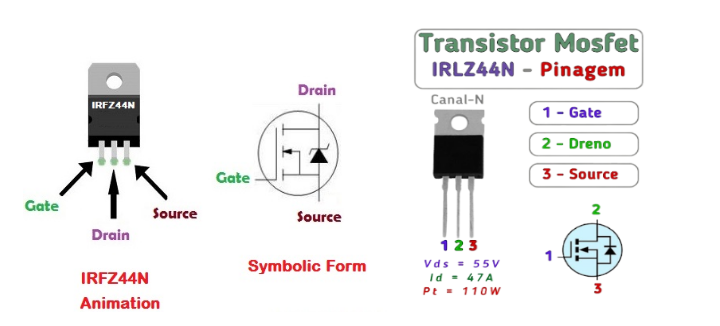
The IRLZ44N and IRFZ44N, despite their differences in electrical characteristics, share identical pinout configurations due to their common TO-220 package design. This package standardization allows for physical interchangeability, though electrical compatibility depends on system requirements.
Both MOSFETs feature three pins in the standard TO-220 through-hole package, with the following pin assignments (viewed from the front, with pins facing you):


  1. Pin 1: Gate (G)
    Controls the MOSFET's conduction by applying a voltage relative to the source. For IRLZ44N (logic-level), this can be driven directly by 3.3V/5V logic. IRFZ44N typically requires 10V for optimal performance.
  2. Pin 2: Drain (D)
    Connects to the load or power supply. This pin is electrically isolated from the heatsink tab in some versions, though the tab is often internally connected to the drain for better thermal conduction.
  3. Pin 3: Source (S)
    Serves as the return path for both the load current and gate drive current. It is usually connected to the circuit ground or a lower potential point.
The identical pinouts mean IRLZ44N and IRFZ44N can physically replace each other in a circuit, but their differing electrical requirements (especially gate voltage) mean this substitution is only functionally valid after verifying system compatibility. Always check gate drive voltage, current handling, and thermal management when considering replacement.
 

IRLZ44N vs IRFZ44N: Physical and Thermal Characteristics

Both MOSFETs are typically available in the TO-220 package, providing good thermal performance. However, there are subtle differences:
  1. Thermal Resistance: Both have similar junction-to-case thermal resistance (~0.8°C/W), but the higher current capability of the IRFZ44N means it can dissipate more power when properly heatsinked.
  2. Package Markings: The part numbers are clearly marked on the packages, with "IRLZ44N" and "IRFZ44N" distinguishing the two devices.

IRLZ44N vs IRFZ44N: Applications

Ideal Applications for IRLZ44N

  1. Microcontroller-based systems requiring direct MOSFET control without gate drivers
  2. Battery-powered devices (3.3V or 5V systems)
  3. DC motor drives with moderate current requirements
  4. Low-power DC-DC converters
  5. LED lighting controls
  6. Portable electronics power management
  7. Circuits where simplicity and reduced component count are priorities

Ideal Applications for IRFZ44N

  1. High-current power supplies and converters
  2. Motor controllers handling large currents
  3. Inverters and power conversion systems
  4. Audio amplifiers
  5. Industrial automation equipment
  6. Automotive power systems
  7. Applications where 10V gate drive is readily available
  8. High-power switching circuits

IRLZ44N vs IRFZ44N: Design Considerations

When choosing between these MOSFETs, consider the following:
Gate Drive Voltage: If your system provides only 3.3V or 5V logic levels without gate drivers, the IRLZ44N is the clear choice.
Current Requirements: For applications exceeding 30A continuous current, the IRFZ44N becomes necessary.
Efficiency Needs: At 5V gate drive, IRLZ44N offers lower conduction losses. At 10V drive, IRFZ44N is more efficient for high-current applications.
Switching Frequency: For high-frequency applications with low gate drive voltage, IRLZ44N's lower gate charge provides better performance.
Component Count: Using IRLZ44N can eliminate the need for gate driver circuitry, reducing cost and board space.

Interchangeability Considerations

While these MOSFETs share the same package and voltage rating, they are not generally interchangeable without circuit modifications:
 
  1. Substituting IRFZ44N with IRLZ44N in a 10V gate drive system will increase conduction losses.
  2. Replacing IRLZ44N with IRFZ44N in a 5V logic system will result in higher on-resistance and possible overheating due to insufficient gate drive.

Conclusion

The IRLZ44N and IRFZ44N, while similar in appearance and voltage rating, are optimized for different operating conditions. The IRLZ44N's logic-level gate drive capability makes it ideal for microcontroller-based systems and low-voltage applications, offering simplicity and good performance at 3.3V or 5V drive. The IRFZ44N, requiring higher gate voltages, provides superior current handling and lower on-resistance when properly driven, making it better suited for high-power applications.
Engineers should carefully evaluate their specific system requirements—particularly gate drive voltage and current levels—when selecting between these devices. By matching the MOSFET's characteristics to the application's needs, designers can optimize efficiency, reliability, and cost-effectiveness in their power electronic systems.


Related Products


IRFZ44NS      IRLZ44NLCL    IRLZ44NPBF


Related News
Read More >>
LDK220 LDO Voltage Regulators Specifications, Features, Pinout, and Applications LDK220 LDO Voltage Regulators Specifications, Features, Pinout, and Applications
Feb .02.2026
The LDK220 series of low-dropout linear regulators (LDOs) is a high-performance device designed specifically for low-power consumption and high-precision voltage regulation, widely used in scenarios such as consumer electronics, industrial control, and po
Xilinx Spartan®-7 FPGA Family: A High-Performance and Energy-Efficient Solution for Mid-Range FPGAs Xilinx Spartan®-7 FPGA Family: A High-Performance and Energy-Efficient Solution for Mid-Range FPGAs
Jan .20.2026
Xilinx Spartan®-7 FPGA Family stands as a defining solution in the mid-range FPGA landscape, blending high performance, energy efficiency, and cost-effectiveness to redefine versatility for industrial, IoT, and consumer electronics applications. Built on
Altera FLEX Series: Architecture, Innovation, and Application Across Four Generations Altera FLEX Series: Architecture, Innovation, and Application Across Four Generations
Jan .07.2026
The Altera FLEX series was more than a lineup of FPGAs—it was a blueprint for how programmable logic devices could evolve to meet diverse market needs. The FLEX 8000 laid the architectural groundwork, the FLEX 10K redefined functionality with embedded mem
LM4765 vs. LM4766: A Comprehensive Comparison of Dual-Channel Audio Power Amplifiers LM4765 vs. LM4766: A Comprehensive Comparison of Dual-Channel Audio Power Amplifiers
Dec .16.2025
Among TI standout offerings, the LM4765 and LM4766 are dual-channel amplifiers designed to cater to diverse audio needs—from compact setups to high-fidelity systems. While sharing the same product lineage, these chips differ significantly in power output,