Company News

XC2C256 CoolRunner-II CPLD

Views : 146
Update time : 2025-08-27 10:30:44
As a core Complex Programmable Logic Device (CPLD) in the Xilinx CoolRunner-II series, the XC2C256 has become a classic benchmark in the medium-density programmable logic field, thanks to its core features of "ultra-low power consumption + industrial-grade high reliability". Based on 256 macrocells, it builds a logic core with 6000 equivalent gates, and achieves a key breakthrough through an innovative architecture: it has a static power consumption of only 5mA under a 3.3V supply, while meeting the requirements of a wide temperature operating range (-40°C to +100°C) and multi-level compatibility (e.g., 5V TTL, 3.3V LVCMOS, 2.5V LVCMOS). This makes it perfectly suitable for scenarios with strict demands on power consumption, stability, and environmental adaptability.
This article will conduct an in-depth analysis from the technical essence to practical value: first, it will dissect its core technical architecture, including the composition logic of the logic core, resource configuration methods, and key hardware design details; then, it will deeply interpret the performance parameters and industrial-grade characteristics, specifying the technical support for speed grades (ranging from -5 to -10, with a maximum propagation delay as low as 4.5ns), power supply characteristics, and wide environmental adaptability; subsequently, it will sort out its development support ecosystem (such as the Xilinx ISE design suite) and flexible programming methods (JTAG in-system programming, SPI offline programming); finally, combined with scenario-based cases, it will demonstrate the application value of this device in fields such as industrial control and communication equipment, highlighting its practical advantages as a "low-power medium-density programmable logic solution".


XC2C256 CoolRunner-II CPLD Overview

The XC2C256 is a mid-density Complex Programmable Logic Device (CPLD) from Xilinx's (now AMD's) CoolRunner-II series. Officially released in March 2007 alongside document DS094 version 3.2, it stands as a typical solution balancing low power consumption and industrial-grade reliability.
Its core logic comprises 256 macrocells, equivalent to a 6,000-gate scale. Adopting a Programmable Logic Array (PLA) architecture, combined with 8 Function Blocks (FBs) and an Advanced Interconnect Matrix (AIM), it achieves 100% resource utilization and flexible logic configuration.
In terms of performance, it features a static power consumption of only 5mA@3.3V, with dynamic power consumption adapting to logic activity. It supports wide-temperature operation from -40℃ to +100℃ and is equipped with HBM±2kV ESD protection, making it suitable for harsh industrial environments. Its multi-I/O banks are compatible with 1.5V-3.3V voltage levels, and non-volatile EEPROM ensures configuration retention even after power loss.
Leveraging the Xilinx ISE WebPACK toolchain and IEEE 1532 JTAG programming, it can flexibly implement combinational and sequential logic. Widely applied in industrial control, communication interface conversion, portable devices, and other scenarios, it remains a classic choice in the field of mid-density programmable logic.


XC2C256 CoolRunner-II CPLD Architecture

The XC2C256 CoolRunner-II CPLD features a low-power, flexible architecture optimized for medium-density logic applications, integrating core components that balance performance, power efficiency, and configurability. Its architecture can be broken down into key functional blocks:

1. Logic Array Blocks (LABs)

The core logic is organized into 16 Logic Array Blocks (LABs), each containing 16 macrocells—totaling 256 macrocells (the "256" in its model number). LABs serve as localized logic clusters, enabling efficient routing of signals between adjacent macrocells to minimize delay and power consumption. Each LAB shares a dedicated product-term array, which generates combinational logic functions (e.g., AND/OR gates) for its macrocells, with flexible product-term allocation to support complex logic expressions.

2. Macrocells

Each macrocell is the basic building block for both combinational and sequential logic. It includes:
  • A product-term logic array (fed by LAB inputs) to implement combinational functions.
  • A D-type flip-flop with programmable asynchronous reset/set, supporting edge-triggered or level-sensitive operation for sequential logic (e.g., counters, registers).
  • Muxes to route signals between the product-term array and flip-flop, enabling dynamic switching between combinational and registered outputs.
This flexibility allows macrocells to adapt to diverse logic needs, from simple gates to complex state machines.

3. Interconnect Network

A hierarchical routing structure connects LABs, I/O banks, and clock resources, balancing speed and power:
  • Local interconnect: Links macrocells within the same LAB for fast, low-power signal transfer.
  • Global interconnect: Distributes high-fanout signals (e.g., clocks, reset) across the entire device with minimal skew, ensuring timing consistency.
  • Direct interconnect: Provides dedicated paths between adjacent LABs and I/O banks to reduce routing delays for critical signals.

4. I/O Banks

The XC2C256 features 8 I/O banks (64 total I/O pins), each supporting multi-voltage operation (1.5V, 1.8V, 2.5V, 3.3V) via programmable I/O buffers. This enables seamless interfacing with legacy 5V systems (via voltage translation) and modern low-voltage devices (e.g., 3.3V ADCs, 1.8V sensors). Each bank includes ESD protection (HBM ±2kV) and configurable slew-rate control to balance signal integrity and EMI.

5. Clock Distribution Network

A dedicated global clock tree supports up to 4 primary clock sources, with buffers to distribute clocks to all LABs and I/O banks. This minimizes clock skew (<1ns) across the device, critical for synchronous logic (e.g., high-speed data sampling). The network also allows clock gating to disable unused clock paths, reducing dynamic power.

6. Configuration & Power Management

  • Non-volatile configuration: Uses on-chip EEPROM to store logic configurations, retaining data during power-off and enabling instant startup without external boot devices.
  • Low-power design: Integrates dynamic power management—idle LABs, I/O banks, or clock domains can be powered down via software, reducing static current to as low as 5mA (typical) for battery-powered applications.
 

XC2C256 Industrial-Grade Performance & Reliability

The XC2C256 is engineered to thrive in harsh environments, with specifications that exceed commercial-grade standards:
Parameter Specification
Operating Temperature Range -40°C to +100°C (industrial grade; extended temperature options available for aerospace use)
Speed Grades Covers -5 (fastest) to -10 (cost-optimized); maximum propagation delay (tPD) as low as 4.5ns
Voltage Tolerance                                    Core voltage (VCC): 3.3V ±5%; I/O voltage (VCCIO): 2.5V/3.3V/5V ±10%
Reliability MTBF (Mean Time Between Failures) > 10^7 hours; ESD protection (HBM) > 2kV
EMI Compliance Meets CISPR 22 Class B (radiated emissions); built-in slew rate control reduces noise
 

XC2C256 CoolRunner-II CPLD Features

1. Logic Resources & Architecture

  • 256 Macrocells: Equivalent to 6,000 logic gates, supporting both combinational logic (multiplexers, arithmetic units) and sequential logic (counters, state machines) via configurable flip-flops.
  • PLA Architecture: Uses a Programmable Logic Array with 100% product-term utilization, eliminating resource waste compared to traditional PAL structures. Enables efficient sharing of logic resources across 8 functional blocks (FBs).
  • Advanced Interconnect Matrix (AIM): Seamlessly connects functional blocks, ensuring low-latency signal routing for complex multi-module designs.

2. Ultra-Low Power Consumption

  • Static Power: 5mA@3.3V, significantly lower than legacy CPLDs (up to 90% reduction), ideal for battery-powered devices.
  • Dynamic Power Scaling: Power consumption adapts to logic activity—minimized during idle states, making it suitable for energy-constrained applications (e.g., wearables, portable medical tools).
  • Power Management: Integrates DataGATE technology to disable unused functional blocks, further reducing standby power.

3. Industrial-Grade Reliability

  • Wide Temperature Range: Operates from -40°C to +100°C, meeting harsh industrial and automotive environment requirements.
  • ESD Protection: HBM (Human Body Model) ±2kV ESD tolerance on all I/O pins, enhancing robustness in electrostatic-prone settings.
  • Noise Immunity: Schmitt-trigger inputs suppress ±500mV noise, ensuring stable operation in electrically noisy industrial fields.

4. Flexible I/O Capabilities

  • Multi-Voltage Support: 4 I/O banks with 1.5V/1.8V/2.5V/3.3V compatibility, enabling seamless integration with legacy 5V systems and modern low-voltage circuits.
  • Rich I/O Features: 184 user I/Os (in 256BGA package) with programmable pull-up/down resistors, open-drain outputs (Wired-OR), and bus-hold functions.
  • 5V Tolerance: Select I/O pins tolerate 5V signals, simplifying interface with older industrial equipment.

5. Clock & Timing Control

  • Dual-Edge Triggered Registers: Capture data on both rising and falling clock edges, effectively doubling timing resolution without increasing clock frequency.
  • Programmable Clock Dividers: 8-level dividers (2–16x) for flexible clock management, balancing performance and power (e.g., converting 100MHz to 12.5MHz for low-power modes).
  • Global Clock Distribution: Low-skew global clock nets ensure synchronous operation across all functional blocks, critical for high-speed data paths.

6. Non-Volatile Configuration

  • EEPROM Storage: Embedded non-volatile memory retains configuration data during power loss, eliminating the need for external configuration chips (unlike FPGAs). Ensures instant startup and system stability.

7. Development & Programming Support

  • Toolchain Compatibility: Fully supported by Xilinx ISE WebPACK (free) and Vivado, with Verilog/VHDL support and schematic input for flexible design entry.
  • In-System Programming: IEEE 1532 JTAG compliance enables in-circuit programming and boundary-scan testing, simplifying prototyping and field upgrades.
  • Dynamic Reconfiguration (OTF): On-The-Fly reconfiguration allows logic updates without power cycling, ideal for remote industrial equipment upgrades.

8. Package Diversity

  • 12 package options, from 3×3mm CSP (chip-scale) for miniaturized devices to 256-ball BGA for high-I/O density industrial controllers, all RoHS-compliant and lead-free.
These features make the XC2C256 a versatile choice for industrial control, communication gateways, portable electronics, and medical devices—balancing performance, power, and reliability in mid-density logic applications.
 

XC2C256 Development Support & Programming

Xilinx provides a robust ecosystem to simplify XC2C256 design and deployment:

4.1 Design Tools

  • Primary Suite: Xilinx ISE Design Suite (including Project Navigator, Synthesis Tool, and Implementation Tool)—supports Verilog, VHDL, and schematic-based design entry.
  • Simulation Integration: Compatible with third-party simulators (e.g., ModelSim, Xilinx ISim) for pre-silicon validation of logic functionality and timing.

4.2 Programming Methods

The device offers two flexible programming options to suit production and field-upgrade needs:
  • JTAG In-System Programming (ISP): Uses the IEEE 1149.1 JTAG interface to program the device while it is mounted on the PCB—enables fast prototyping and field updates.
  • SPI Offline Programming: Programs the device via an external SPI flash memory (e.g., Xilinx Platform Flash) during production—ideal for high-volume manufacturing.

4.3 Hardware Support

Xilinx and third-party vendors offer evaluation kits (e.g., XC2C256-TQ144 Evaluation Board) with pre-built circuits for testing I/O, logic, and power performance—reducing time-to-prototype.
 

XC2C256 Applications

The XC2C256 CoolRunner-II CPLD, with its low power consumption, wide temperature adaptability, multi-level compatibility, and flexible logic configuration capabilities, serves as a key logic control unit in multiple fields. Its specific applications are as follows:
Industrial Automation: As the core for I/O expansion in PLCs (Programmable Logic Controllers), it uses 256 macrocells to parallel process over 100 sensor signals (such as temperature, pressure, and limit switches). Leveraging the 1.5V-3.3V level compatibility of multiple I/O banks, it seamlessly connects legacy 5V relays with modern 3.3V ADC modules. Its wide temperature design (-40℃~+100℃) and HBM ±2kV ESD protection allow direct deployment in industrial control cabinets, enabling real-time logical linkage of production line equipment (e.g., conveyor start/stop, valve switching sequence control).
Communication Interface Conversion: In industrial Ethernet gateways, it undertakes bridging logic between UART/SPI/I²C and EtherCAT protocols. Using dual-edge-triggered registers, it achieves 166MHz high-speed data forwarding. Meanwhile, utilizing the resource-sharing capability of the PLA architecture, it integrates CRC verification and data frame parsing functions, simplifying hardware design for multi-protocol conversion. For embedded devices, it can act as an interface adaptation unit between USB 2.0 and GPIO, solving incompatibility issues of different interface levels.
Portable Smart Devices: In wearable health monitors, its 3×3mm CSP package integrates control logic for 6-axis motion sensors, heart rate modules, and OLED screens. With a 5mA quiescent current and dynamic power management (shutting down idle I/O banks), it extends device battery life to over 7 days. Non-volatile EEPROM stores configuration information, ensuring the device quickly resumes operation after power-off and restart without re-initialization.
Medical Instrument Control: In portable ultrasound diagnostic equipment, 256 macrocells simultaneously implement probe array drive timing generation (accurate to 10ns level) and image data buffer control. The global clock distribution network synchronizes multi-channel AD sampling, and its wide temperature characteristics adapt to complex environments such as field emergency vehicles. Its dynamically reconfigurable logic supports in-system updates of probe drive algorithms via JTAG, enhancing device upgrade flexibility.
These applications all rely on its core advantages of "low power consumption + high reliability + flexible configuration," making it an efficient solution for medium-density logic scenarios.


XC2C256 Package 

A range of package types accommodates varying space constraints and I/O needs, all RoHS-compliant for environmental compatibility:
                                                
  • 100-pin VQFP (Very Thin Quad Flat Pack): Compact footprint with ~80 usable I/O pins, suited for space-constrained embedded systems (e.g., small-scale industrial sensors).
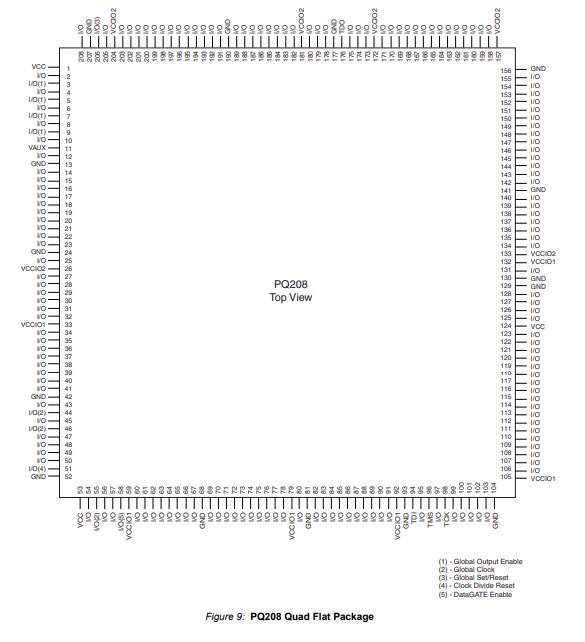
  • 208-pin PQFP (Plastic Quad Flat Pack): Provides 160+ I/O pins, including 5V-tolerant pins, making it ideal for legacy 5V system integration (e.g., PLC expansion modules).
  • 256-ball BGA (Ball Grid Array): Offers 184 user I/O pins with high-density interconnects, designed for complex industrial controllers requiring extensive I/O (e.g., multi-channel communication gateways).
  • 3×3mm CSP (Chip Scale Package): Ultra-miniature form factor for wearable or portable devices (e.g., medical wearables), balancing small size with 256 macrocells of logic capacity.
 

XC2C256 CoolRunner-II CPLD Series Models

Part Number Pin/Ball Spacing θJA (C/Watt) θJC (C/Watt) Package Type Package Body Dimensions I/O Commercial (C) Industrial (I)(1)
XC2C256-6VQ100C 0.5mm 43.1 10.9 Very Thin Quad Flat Pack 14mm x 14mm 80 C  
XC2C256-7VQ100C 0.5mm 43.1 10.9 Very Thin Quad Flat Pack 14mm x 14mm 80 C  
XC2C256-6CP132C 0.5mm 65.0 15.0 Chip Scale Package 8mm x 8mm 106 C  
XC2C256-7CP132C 0.5mm 65.0 15.0 Chip Scale Package 8mm x 8mm 106 C  
XC2C256-6TQ144C 0.5mm 37.2 7.2 Thin Quad Flat Pack 20mm x 20mm 118 C  
XC2C256-7TQ144C 0.5mm 37.2 7.2 Thin Quad Flat Pack 20mm x 20mm 118 C  
XC2C256-6PQ208C 0.5mm 36.9 9.7 Plastic Quad Flat Pack 28mm x 28mm 173 C  
XC2C256-7PQ208C 0.5mm 36.9 9.7 Plastic Quad Flat Pack 28mm x 28mm 173 C  
XC2C256-6FT256C 1.0mm 34.6 6.1 Fine Pitch Thin BGA 17mm x 17mm 184 C  
XC2C256-7FT256C 1.0mm 34.6 6.1 Fine Pitch Thin BGA 17mm x 17mm 184 C  
XC2C256-6VQG100C 0.5mm 43.1 10.9 Very Thin Quad Flat Pack; Pb-free 14mm x 14mm 80 C  
XC2C256-7VQG100C 0.5mm 43.1 10.9 Very Thin Quad Flat Pack; Pb-free 14mm x 14mm 80 C  
XC2C256-6CPG132C 0.5mm 65.0 15.0 Chip Scale Package; Pb-free 8mm x 8mm 106 C  
XC2C256-7CPG132C 0.5mm 65.0 15.0 Chip Scale Package; Pb-free 8mm x 8mm 106 C  
XC2C256-6TQG144C 0.5mm 37.2 7.2 Thin Quad Flat Pack; Pb-free 20mm x 20mm 118 C  
XC2C256-7TQG144C 0.5mm 37.2 7.2 Thin Quad Flat Pack; Pb-free 20mm x 20mm 118 C  
XC2C256-6PQG208C 0.5mm 36.9 9.7 Plastic Quad Flat Pack; Pb-free 28mm x 28mm 173 C  
XC2C256-7PQG208C 0.5mm 36.9 9.7 Plastic Quad Flat Pack; Pb-free 28mm x 28mm 173 C  
XC2C256-6FTG256C 1.0mm 34.6 6.1 Fine Pitch Thin BGA; Pb-free 17mm x 17mm 184 C  
XC2C256-7FTG256C 1.0mm 34.6 6.1 Fine Pitch Thin BGA; Pb-free 17mm x 17mm 184 C  
XC2C256-7VQ100I 0.5mm 43.1 10.9 Very Thin Quad Flat Pack 14mm x 14mm 80   I
XC2C256-7CP132I 0.5mm 65.0 15.0 Chip Scale Package 8mm x 8mm 106   I
XC2C256-7TQ144I 0.5mm 37.2 7.2 Thin Quad Flat Pack 20mm x 20mm 118   I
XC2C256-7PQ208I 0.5mm 36.9 9.7 Plastic Quad Flat Pack 28mm x 28mm 173   I
XC2C256-7FT256I 1.0mm 34.6 6.1 Fine Pitch Thin BGA 17mm x 17mm 184   I
XC2C256-7VQG100I 0.5mm 43.1 10.9 Very Thin Quad Flat Pack; Pb-free 14mm x 14mm 80   I
XC2C256-7CPG132I 0.5mm 65.0 15.0 Chip Scale Package; Pb-free 8mm x 8mm 106   I
XC2C256-7TQG144I 0.5mm 37.2 7.2 Thin Quad Flat Pack; Pb-free 20mm x 20mm 118   I
XC2C256-7PQG208I 0.5mm 36.9 9.7 Plastic Quad Flat Pack; Pb-free 28mm x 28mm 173   I
XC2C256-7FTG256I 1.0mm 34.6 6.1 Fine Pitch Thin BGA; Pb-free 17mm x 17mm 184   I
 

Conclusion

Though Xilinx (now part of Intel) has launched newer CPLD/FPGA families, the XC2C256 remains a benchmark for medium-density, low-power programmable logic. Its success lies in solving a specific, unmet need: delivering "just enough" logic resources without sacrificing power efficiency or industrial robustness. For legacy systems or applications where cost, power, and reliability are prioritized over cutting-edge performance, the XC2C256 continues to be a trusted choice—solidifying its status as a classic in programmable logic history.

If you're looking for a CPLD for your industrial-grade project, give this series of models a try! Contact us for the latest quotes and Datasheets!
 

XC2C256 Datasheet

Related News
Read More >>
LDK220 LDO Voltage Regulators Specifications, Features, Pinout, and Applications LDK220 LDO Voltage Regulators Specifications, Features, Pinout, and Applications
Feb .02.2026
The LDK220 series of low-dropout linear regulators (LDOs) is a high-performance device designed specifically for low-power consumption and high-precision voltage regulation, widely used in scenarios such as consumer electronics, industrial control, and po
Xilinx Spartan®-7 FPGA Family: A High-Performance and Energy-Efficient Solution for Mid-Range FPGAs Xilinx Spartan®-7 FPGA Family: A High-Performance and Energy-Efficient Solution for Mid-Range FPGAs
Jan .20.2026
Xilinx Spartan®-7 FPGA Family stands as a defining solution in the mid-range FPGA landscape, blending high performance, energy efficiency, and cost-effectiveness to redefine versatility for industrial, IoT, and consumer electronics applications. Built on
Altera FLEX Series: Architecture, Innovation, and Application Across Four Generations Altera FLEX Series: Architecture, Innovation, and Application Across Four Generations
Jan .07.2026
The Altera FLEX series was more than a lineup of FPGAs—it was a blueprint for how programmable logic devices could evolve to meet diverse market needs. The FLEX 8000 laid the architectural groundwork, the FLEX 10K redefined functionality with embedded mem
LM4765 vs. LM4766: A Comprehensive Comparison of Dual-Channel Audio Power Amplifiers LM4765 vs. LM4766: A Comprehensive Comparison of Dual-Channel Audio Power Amplifiers
Dec .16.2025
Among TI standout offerings, the LM4765 and LM4766 are dual-channel amplifiers designed to cater to diverse audio needs—from compact setups to high-fidelity systems. While sharing the same product lineage, these chips differ significantly in power output,